Private, on-device interview transcription

On the record.Off the cloud.

Kayit transcribes your interviews locally, on your Mac, your iPhone or your iPad, and transcribing is free: three on-device engines, a hundred languages and an editor where correcting a word keeps its timing. Kayit Pro adds what you build on top of the words, from speaker separation to quotes with their audio. Nothing is processed in the cloud on either tier.

  • Mac (M1 or later), iPhone and iPad
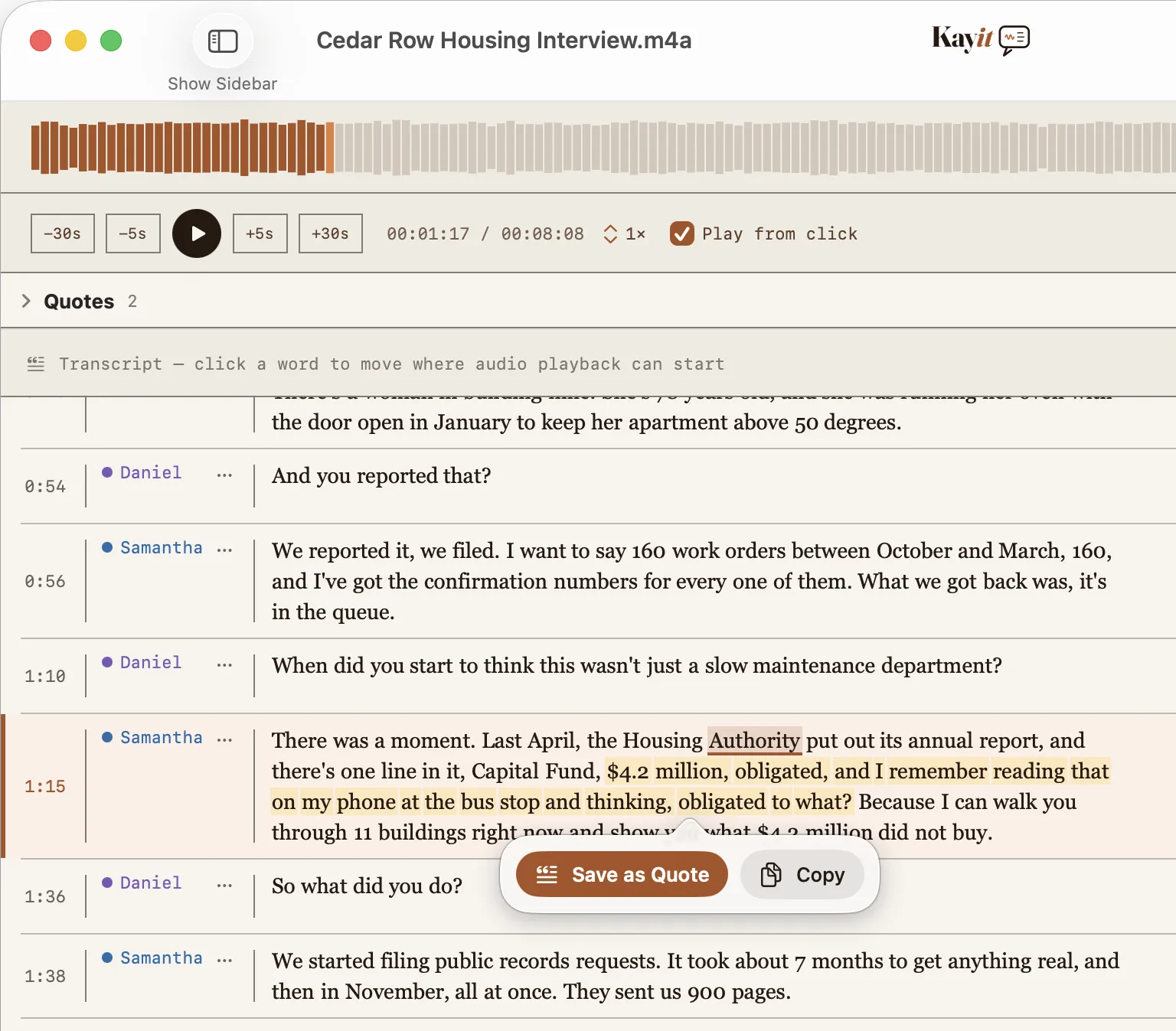
The Kayit window: a waveform and transport bar above a transcript of an interview, each paragraph tagged with a timestamp and a speaker name. A passage is selected and a callout offers Save as Quote.

Free

A hundred languages across three engines, chosen per interview

Pick the trade-off each recording deserves: Apple, Parakeet or Whisper. Choose the language first and Kayit grays out any engine that can't handle it, with the reason and a time estimate, before you commit. All three run on-device; none of them is a network call after the initial download of the engine.
Free

Edit the transcript without breaking the record

Edit paragraphs with real Mac text editing, and the timestamps survive. Fix a typo and every word keeps its exact timing, so playback stays aligned to the words you corrected. Autocorrect, smart quotes and Writing Tools are switched off in the editor, so nothing can rewrite a source's words for you.

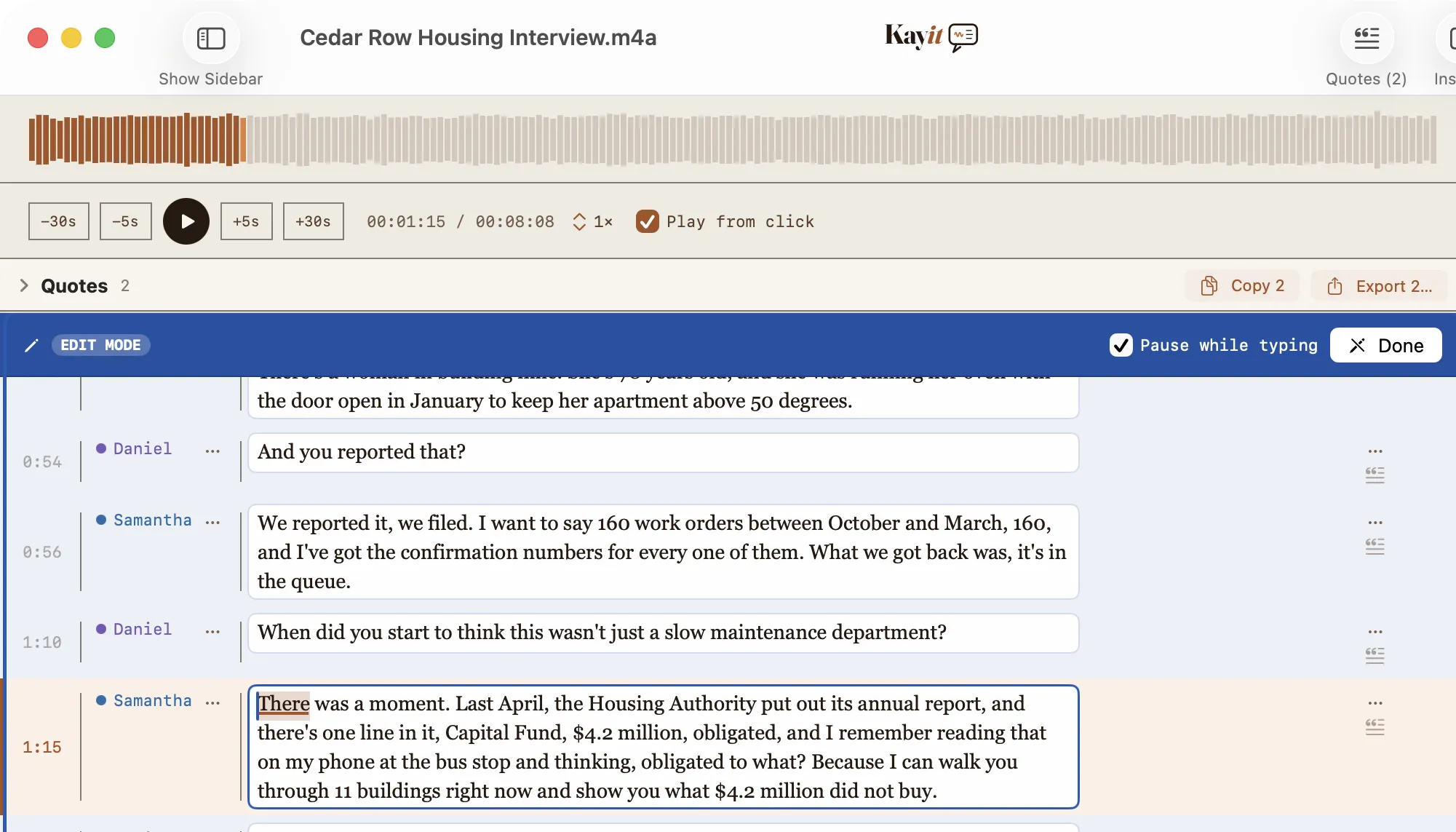
Kayit in edit mode: the transcript surface turns blue, a status bar reads EDIT MODE with a Pause while typing checkbox, and one paragraph is framed as an editable text field.
Edit it like any other text on your Mac: fix a mangled name or a typo, and the text->audio sync still works when playing the audio. The interview is fictional.

Free

Getting the audio in takes one gesture

Share straight from Voice Memos, which has no export of its own. Right-click ▸ Open With in Finder, or drop a file on the window. On iPhone and iPad it is the share sheet, from Voice Memos or Files. Drop in a video and Kayit takes the audio track, leaving your file untouched.

Kayit Pro

Knows who's speaking

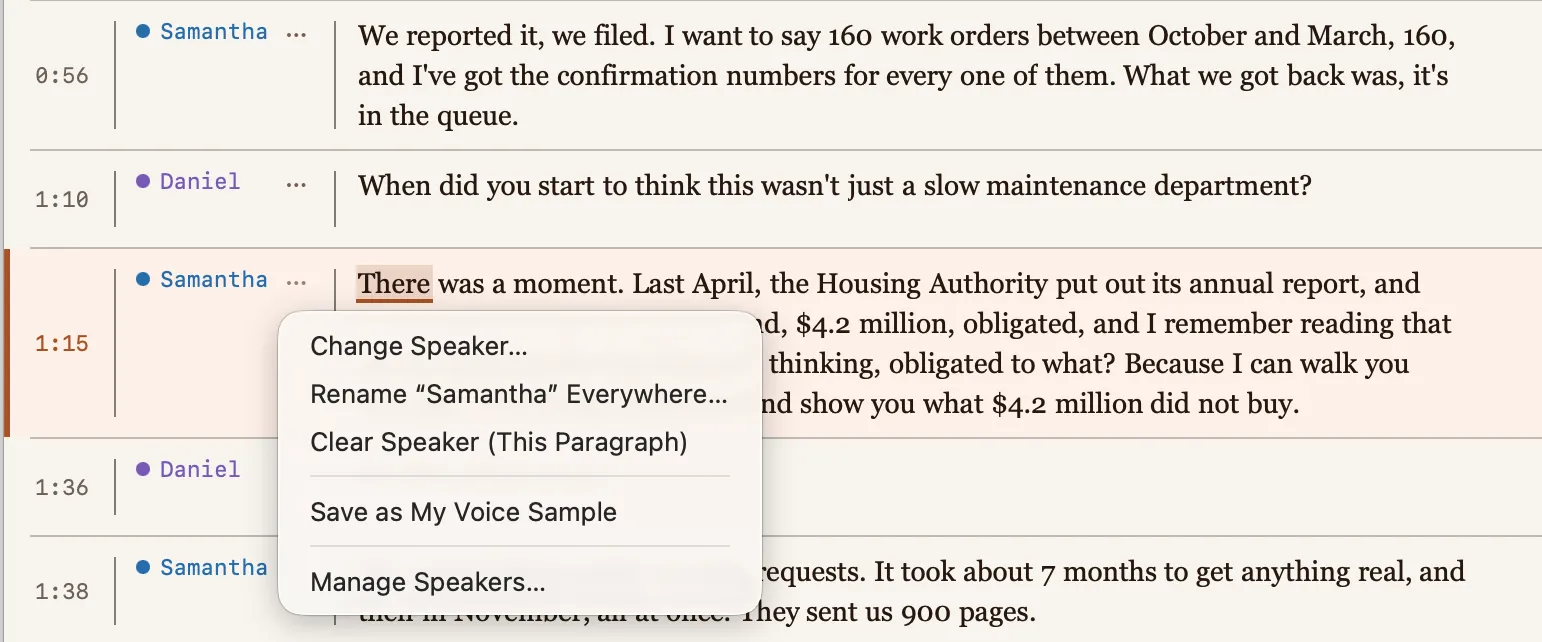
Automatic speaker separation splits the transcript every time the speaker changes and labels who is talking. Rename a speaker once and it applies across the whole interview. Save a sample of your own voice from a transcript you have already labeled, and Kayit names you automatically in every interview after that.

Transcript paragraphs labeled Samantha and Daniel, with a menu open offering Change Speaker, Rename Samantha Everywhere, Clear Speaker and Save as My Voice Sample.
The transcript splits every time the speaker changes. Rename one and it applies to the whole interview. The interview is fictional.

Kayit Pro

Finds the passages that matter

An on-device model flags admissions, allegations, contradictions, on-record claims, and financial and legal exposure, linking every one back to the moment in the audio. Set each category's own bar, and see roughly how many passages that will flag before you re-run. Click a passage to see it in context in the transcript. The passage is the transcript's own words rather than a paraphrase, with a line under it from the model saying why it was flagged.

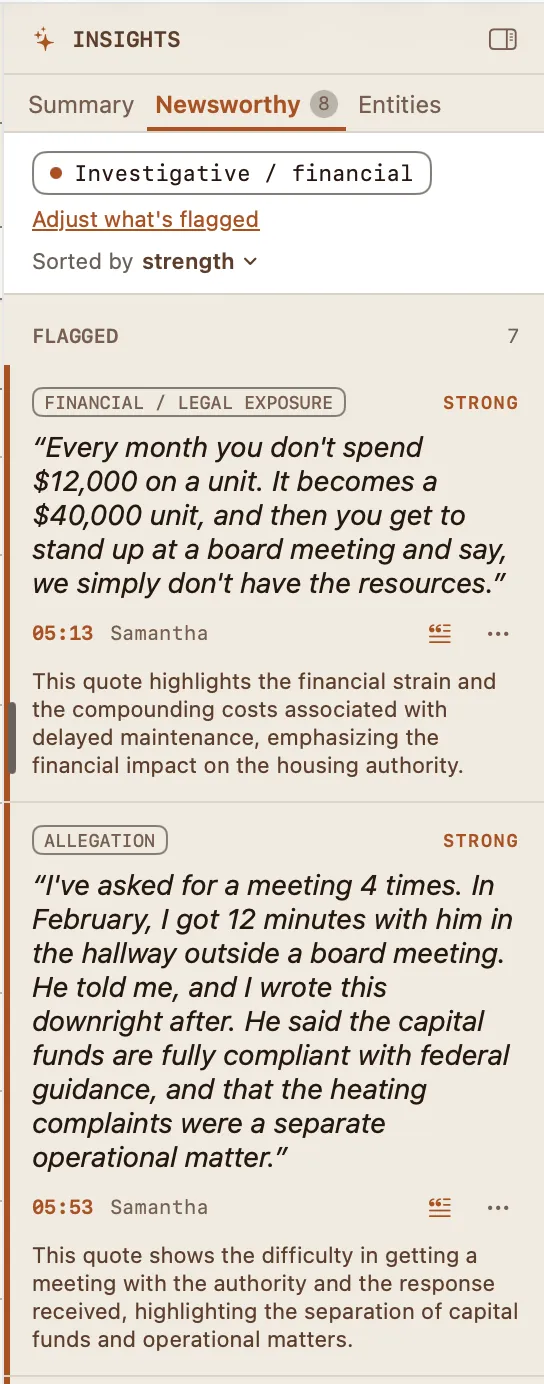
The Insights panel on its Newsworthy tab, listing flagged passages tagged FINANCIAL / LEGAL EXPOSURE and ALLEGATION, each marked STRONG with a timestamp, the speaker and a short rationale.
Passages worth a second look are sorted by how strong the statement is and linked back to the transcript. The interview is fictional.

Kayit Pro

Summary, outline and pull-quotes, with a switch to turn them off

A plain-language summary, a timestamped outline whose entries seek the audio, and suggested quotes anchored to the transcript's real words rather than a paraphrase. It runs on your Mac, and a switch turns it off, enforceable across a whole organization if your policy requires it.

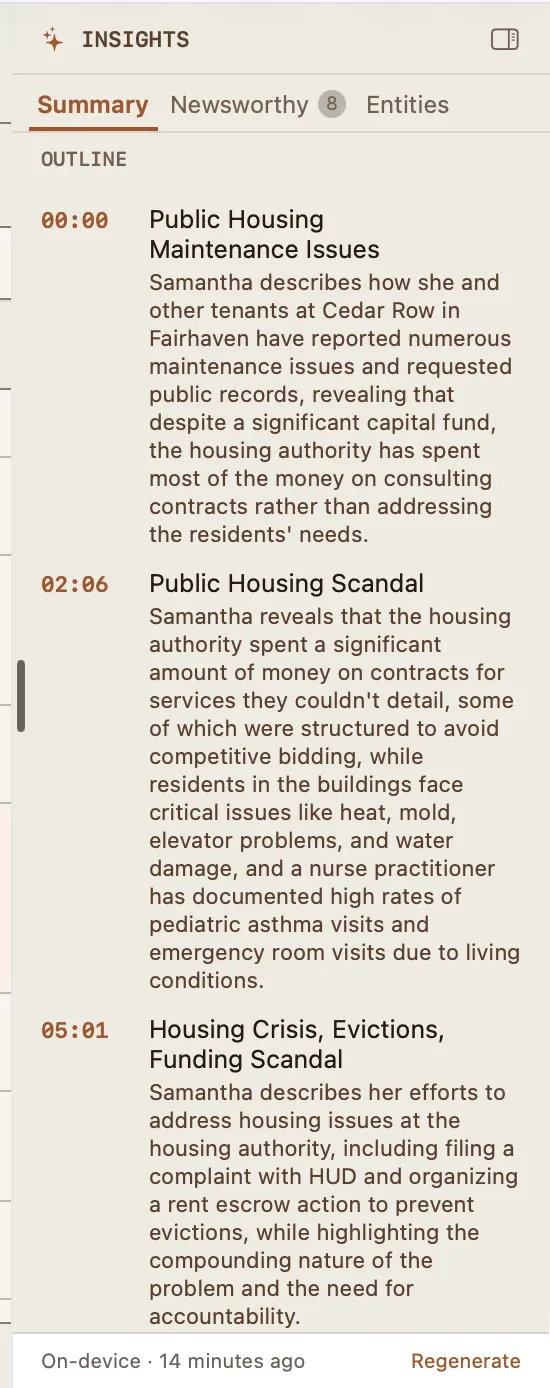
The Insights panel on its Summary tab, showing a timestamped outline of the interview with a paragraph describing each section, and a footer reading On-device, 14 minutes ago.
Timestamped summaries that link back to the part of the transcript they're summarizing. This is the use of locally run generative AI. Turn it off in settings or via MDM. The interview is fictional.

Kayit Pro

File a story's interviews into a project

A project is a folder in your library, so what you see in the sidebar is what the Finder and your backup see, and nothing moves until you ask. One roster of speaker names runs across the project, so a source you have interviewed six times is spelled the same way six times; every quote you saved in it gathers into a single list; and the whole set exports together, audio included. The running list of what you still need lives in the project as a plain Markdown file. Making a project is the part that needs Pro: if a subscription lapses, the projects you have stay open and you can keep filing into them, archiving them and finding what is inside them.

Kayit Pro

Send the whole interview to a colleague

Export the transcript and the audio as one bundle. Someone without Kayit double-clicks the transcript and reads it; someone with it gets the speakers, word timings and your saved quotes without re-transcribing. Sending the words alone costs nothing: plain text is in the free tier, and Pro adds Markdown, CSV, SubRip subtitles, timestamps and anything that carries the audio.

The same interviews on your Mac, iPhone and iPad

One purchase covers all three. The iPhone and iPad app transcribes, plays back, edits, names speakers, saves quotes and exports, with the same free line drawn through it, and the iPad lays that out in three panes with the insights beside the transcript. The AI insights are the one thing the iPhone does not have, for the plain reason that the model needs more memory than a phone has. A saved sample of your voice works on each device but does not yet travel between them. None of the three records; all of them transcribe recordings you already have.

Who it's for

Built for confidential work.
Kayit keeps the recording on your device.

A confidential source's recording is the single file with the most to lose if it leaks. A cloud vendor's breach or a subpoena is a risk because it's not in your hands. The audio never leaves your Mac, iPhone or iPad to be transcribed, so there is no vendor or server holding it and no third party who can be compelled to hand it over. The transcript stays put too: the model that flags passages and writes the optional summary is downloaded to your own device and reads it there, never at a cloud AI service. There is no account either, so nothing on our side carries your name or ties you to a recording.

Built first for journalists, but useful to anyone bound to a confidence. If your IT or security team has blocked cloud transcription outright, Kayit is the tool they can actually approve.

  • Lawyers Speaker labels and word-level timings survive an edit, so a transcript you have corrected still lines up with the recording it was taken from.
  • Researchers There is no processor to name on an ethics application and no transfer to justify, because the recording is never sent anywhere to be transcribed.
  • Clinicians The session is transcribed on the Mac that recorded it, so a patient's words never become a third party's copy to secure, audit or disclose.
  • Investigators A saved quote keeps its speaker, timestamp and exact audio span, so a statement a subject later disputes can be played back the way it was said.
Questions? Read the FAQ ↓
  • Works offline. After a first use model download, disconnect the Wi-Fi and it still transcribes. Nothing in the free tier ever waits on a subscription check, and Pro keeps working for two weeks when the App Store cannot be reached.
  • The generative half switches off. One setting removes the on-device summary and outline. A second removes the note the model writes on why a passage was flagged. Both are standard macOS preferences, so an organization can enforce either with a managed profile.
  • You own the files. Every transcript is written to an open .transcript.json file beside your audio that other tools can read, and exporting it as plain text costs nothing, so there is no lock-in and no tier that holds your words hostage.
  • Cloud-folder warnings. Kayit warns you before saving or exporting interviews into iCloud, Dropbox or other syncing folders.

Free to transcribe, with a subscription for the editorial tools.

Downloading Kayit costs nothing, and neither does transcribing with it. The free tier is a complete local transcriber with no time limit on it. Pro adds the layer built on top of the words, and starts with a 14-day free trial. Cloud tools meter your minutes and cap your uploads; Kayit doesn't, because there is nothing to upload.

Kayit
Freeno account, no card
Everything needed to turn a recording into accurate text you can read, correct and keep.
  • Transcription on-device, all three engines
  • A hundred languages, chosen per interview
  • Playback with the transcript following word by word
  • Search, and your whole library of interviews
  • Edit mode, where a correction keeps its timing
  • Export the whole transcript as plain text

Pro is one subscription with everything in it: no add-ons, no per-minute charges and no upload limits. Bought through the App Store, once, for the Mac, iPhone and iPad apps together. No Kayit account is required for either tier, and no subscription check can hold up a transcription.

Download on the App StoreFree to download and transcribe · macOS 26+ (Tahoe) · iOS and iPadOS 26+